
Across The Americas is the newsletter of independent journalism from the Rio Grande Valley, covering the Texas-Mexico region from a global lens.
Your information is always private.
McAllen, Texas — Since the Trump administration began its campaign of escalating federal immigration agency raids in the region, both documented and undocumented workers alike in the Rio Grande Valley of South Texas are thinking twice about venturing out in public out of fear they may be swept up.
The local economic ripple effects brought on by Trump's mass deportations so far include labor shortages, reduced consumer spending, business closures, and the resulting higher prices for new construction that led to region-wide stalled projects.
Amid this turmoil, additional costs to the region in the form of tax spending are now surfacing. An economic analysis published this month shows that taxpayers in the Rio Grande Valley are set to foot the bill on an estimated $307 million for the mass deportations now being carried out by federal agencies in their own neighborhoods.
That's according to the Cost of Deportations Calculator, produced by the National Priorities Project, part of the Institute for Policy Studies, and published this month by the Economic Policy Institute, a nonprofit think tank focused on economic research.
"The Trump administration's immigration policy is not just inhumane, it is also a huge waste of public resources," said Heidi Shierholz, president of EPI. "Every dollar spent on mass deportations is a dollar not spent on critical investments like education, health care, and affordable housing."
In the Rio Grande Valley, the tax burden will fall unevenly across the region's four counties, with Hidalgo County taxpayers shouldering the largest share of deportation spending at nearly $197.6 million. In Cameron County, taxpayers can expect to pay just over $99 million, with Starr County covering $7.8 million and $2.9 million coming from Willacy.
EPI says the total costs are estimated to be paid in full by taxpayers through the end of Trump's second term as president if current spending levels continue.
The taxpayer cost of Trump's mass deportations by county in the Rio Grande Valley
The think tank also estimated what those funds could have been used for had they not been dedicated to the mass detainment and deportation of undocumented people with no criminal records and the removal of documented non-citizens legally present in the country.
Although the funds were not previously earmarked for specific programs, the analysis provides examples to help the public better understand the opportunity costs of the record-breaking pace at which the federal government is carrying out these enforcement efforts.
In Hidalgo County, the same amount of taxes now being dedicated to federal raids could have provided medical care for almost 4,000 veterans or hired over 800 new full time school teachers. In Cameron County, the funds taxpayers will cover for deportations could have provided Head Start slots for over 3,000 children or hired over 280 full time registered nurses.
How the spending was approved in Congress
Apart from a mix of other federal spending, a majority of the funding for deportations was approved through Trump's One Big Beautiful Bill Act signed into law in 2025 in support of the administration's ultimate goal to deport one million people per year.
Three South Texas-based Congressional House members voted with their party on Trump's signature bill to increase ICE's base budget of $10 billion by an additional $75 billion. Republican Mónica De La Cruz voted for it, while Democrats Vicente Gonzalez and Henry Cuellar voted against.
On the day of the vote, Rep. Mónica De La Cruz said she "proudly voted in support" of Trump's signature legislation. "This legislation delivers for all Americans by solidifying the largest tax cut in history," De La Cruz said in a public statement, without addressing how the bill's costs would affect taxpayers in her district.
Rep. Gonzalez responded to the vote in a press release. “This bill is nothing but One Big Betrayal to the American people," Gonzalez said at the time. "I could not in good conscience vote for legislation that will make South Texans sicker and poorer while making the ultra-rich even richer."
Who voted for Trump's Big Beautiful Bill Act in South Texas?
 Mónica De La Cruz
 Vicente Gonzalez
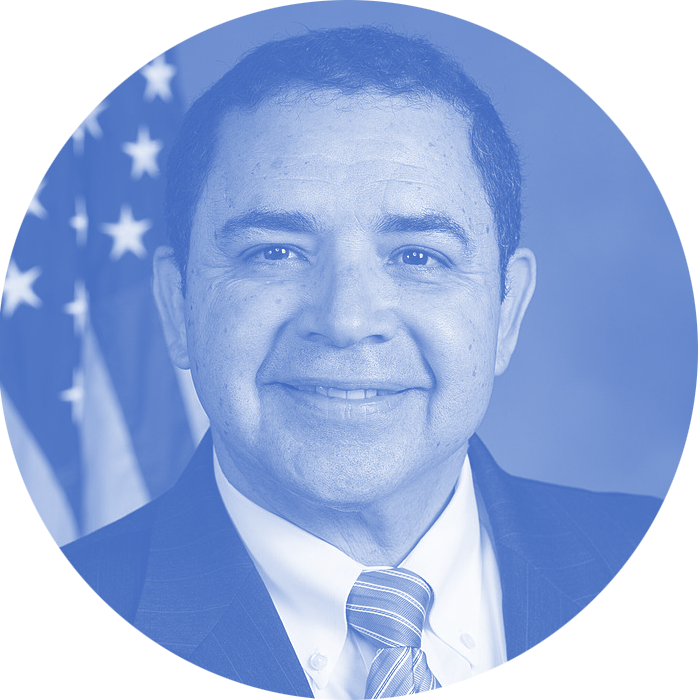 Henry Cuellar
The sum approved by Congress and ultimately signed into law by Trump represents the largest increase in ICE's history. But Congress must again vote for future yearly increases, which may be higher if the Republican party is to reach its goal of one million deportations per year.
A pre-election analysis by the American Immigration Council, a Washington-based immigrant-rights advocacy organization, put the price tag of that yearly pace at $967.9 billion over a decade.
The broader cost to government revenues could be higher
While the EPI calculator measures what taxpayers will spend to fund deportations, other analysts have pointed to the broader fiscal costs to the U.S. government created by the removal of undocumented people and documented non-citizens from the U.S. economy.
In 2024, the Congressional Budget Office projected that the increase in immigration between 2021 and 2026 boosted tax revenues enough to reduce the federal budget deficit by $0.9 trillion.
David Bier, director of immigration studies at the Cato Institute, a libertarian public policy research organization, recently flipped that calculation to show that if more people in the economy means more tax revenue, then removing them must represent a loss.
Bier argues that Trump's deportations will actually cost $900 billion more to the U.S. government over the next ten years than the budget office projected. He says this is because the CBO did not include lost tax revenue from removed individuals who now pay more in taxes than they receive in benefits. The CBO also assumed that enforcement spending will be temporary.
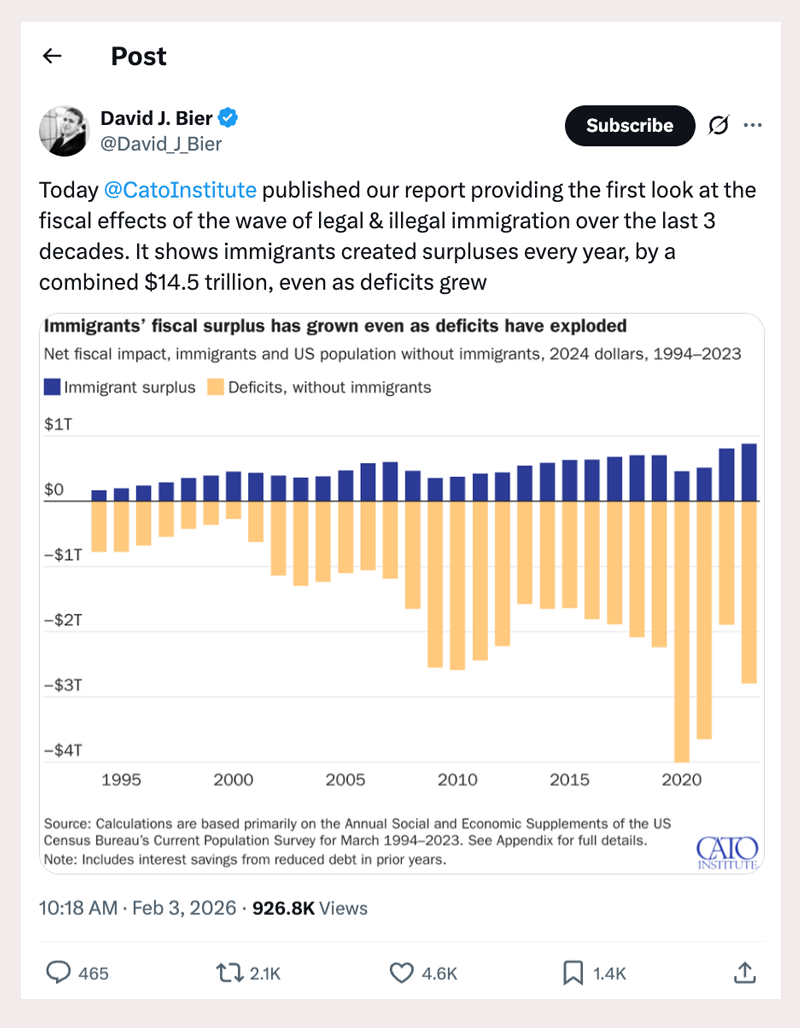
In a separate analysis published in February, Bier went further, calculating that immigrants have generated a fiscal surplus every year for the past three decades, a combined total of $14.5 trillion even as federal deficits grew.
Trump is now mobilizing the currently approved funding to fulfill campaign rhetoric as federal agencies are on track to break post-Eisenhower records of yearly deportations in 2026.
Critics say the operation's scale suggests it is driven more by the politics of Trump's base than by the economic benefits Republicans have repeatedly stated publicly to justify it.
“I don’t know if you call them people,” Trump told a crowd during his presidential campaign in Dayton, Ohio in 2024 about the families he planned to have removed once in office. “In some cases they’re not people, in my opinion, but I’m not allowed to say that because the radical left says that’s a terrible thing to say.”